Building a Successful Retrieval-Augmented Generation (RAG) System
A comprehensive blueprint and architectural guide for building, evaluating, and deploying production-ready Retrieval-Augmented Generation (RAG) pipelines.
Table of Contents
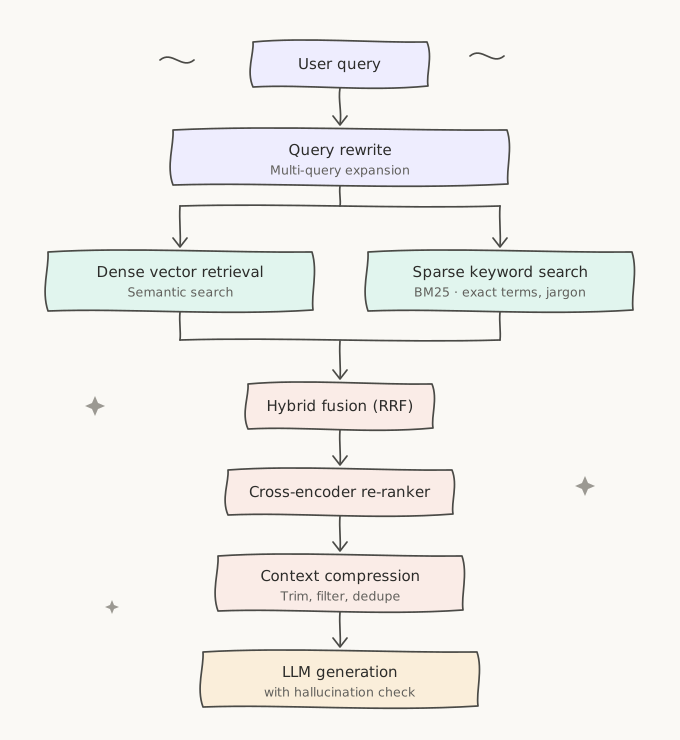
Architecture Overview
Standard RAG follows a simple flow: Document -> Chunks -> Embeddings -> Vector Search -> Context + Prompt -> LLM Answer.
Production RAG requires Advanced RAG techniques to solve core failure points such as low precision, missing context, and hallucinations:
RAG Pipeline: Engineering Reference
A practical reference for building and shipping retrieval-augmented generation systems, ordered by pipeline stage.
Table of Contents
-
Data Ingestion & Indexing
-
Advanced Retrieval Strategies
-
Post-Retrieval Processing & Re-ranking
-
Synthesis & Generation
-
Evaluation & Benchmarking
-
Production Best Practices
1. Data Ingestion & Indexing
1.1 Parsing & Cleaning
| Concern |
Approach |
Tooling |
| Unstructured data |
Extract clean text from tables, PDFs, images, and HTML |
Unstructured, LlamaParse, PyMuPDF |
| Metadata |
Tag author, creation date, source document, section headers |
Custom extractors at ingest time |
Why metadata matters: tags captured at ingest are what make metadata filtering possible at retrieval time. Anything not captured here cannot be filtered on later.
1.2 Chunking Strategies
Chunking directly influences retrieval precision.
| Strategy |
How it works |
Trade-off |
| Fixed-size |
Character/token windows with overlap (e.g. 512 tokens, 50-token overlap) |
High throughput; risks breaking semantic boundaries |
| Recursive character |
Split by structure: paragraphs (\n\n) → sentences (\n) → words ( ) |
Preferred default |
| Semantic |
Group sentences by cosine-similarity spikes in embedding space |
Better boundaries; higher ingest cost |
| Hierarchical (parent-child) |
Index small chunks (~100 tokens) for precision, retrieve parent chunks (~1000 tokens) for context |
Best of both; more index complexity |
2. Advanced Retrieval Strategies
2.1 Hybrid Search
Combine both retrieval modes and fuse the rankings:
-
Dense retrieval — semantic similarity via vector embeddings
-
Sparse retrieval — lexical/keyword match via BM25
-
Fusion — merge the two ranked lists with Reciprocal Rank Fusion (RRF)
2.2 Query Transformation & Rewriting
| Technique |
Description |
Optimizes for |
| Query expansion |
Generate multiple variations of the input query |
Recall |
| HyDE |
Have the LLM write a hypothetical answer, embed that, retrieve similar real documents |
Semantic alignment |
| Sub-query decomposition |
Break complex multi-part queries into simpler sub-queries |
Multi-hop coverage |
3. Post-Retrieval Processing & Re-ranking
-
Cross-encoder re-ranking — vector similarity only measures distance in embedding space. Pass the top-N retrieved documents through a cross-encoder (
bge-reranker-large, Cohere Rerank) to score deep semantic relevance before handing context to the LLM.
-
Context compression & trimming — drop low-relevance sentences and chunks to stay inside the prompt limit and cut API cost.
-
Lost-in-the-middle mitigation — place the most critical context at the very beginning and very end of the prompt window, where attention is highest.
4. Synthesis & Generation
4.1 System Prompting
Enforce strict grounding:
Answer the user question using ONLY the provided context below.
If the answer cannot be deduced from the context, state:
"I do not have enough information to answer."
4.2 Citations & Attribution
Instruct the model to emit inline references (e.g. [Doc 1]) so every claim can be traced back to a source chunk.
5. Evaluation & Benchmarking
Never deploy without quantifying system quality. Evaluate with the RAG Triad (Ragas, TruLens):
| # |
Metric |
Question it answers |
Component under test |
| 1 |
Context relevance |
Are the retrieved chunks relevant to the query? |
Retriever |
| 2 |
Groundedness / faithfulness |
Is the response derived strictly from the context? |
LLM (hallucination rate) |
| 3 |
Answer relevance |
Does the answer address the original query? |
End-to-end pipeline |
6. Production Best Practices
6.1 Latency Optimization
- Asynchronous retrieval
- Cache embeddings for frequent queries
- Stream the LLM response to reduce time-to-first-token (TTFT)
6.2 Observability & Guardrails
Trace latency, token cost, and retrieval quality per query using LangSmith, Phoenix, or OpenTelemetry.
Quick Reference: Pipeline at a Glance
Documents
   ↓  parse + extract metadata
Chunks (recursive / hierarchical)
   ↓  embed + index
Hybrid retrieval (dense + BM25 → RRF)
   ↓  query expansion / HyDE / decomposition
Top-N candidates
   ↓  cross-encoder rerank → compress → reorder
Grounded prompt
   ↓  generate with citations
Answer  →  evaluated on the RAG Triad
